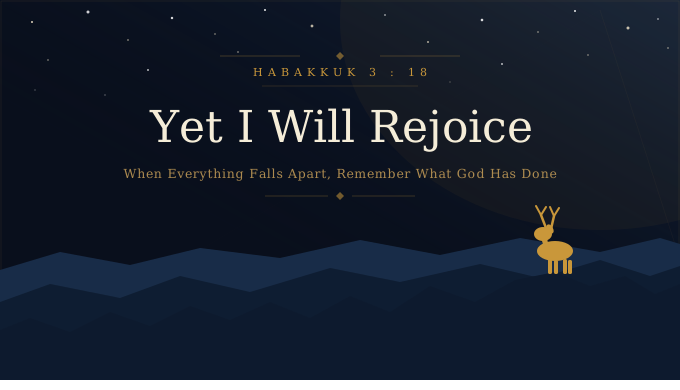
When Everything Falls Apart, Remember What God Has Done
A Reflection on Habakkuk 3
Most of us know the feeling Habakkuk describes — that low, aching dread when life refuses to cooperate with what we believe about God. You believe He is good. You believe He is sovereign. And yet the evidence in front of you seems to argue the exact opposite. Wicked people prosper. Good people suffer. The world tilts further toward injustice with each passing year, and the silence from heaven feels deafening.
Habakkuk knew that feeling intimately. He opens his book with a complaint, not a polite request, but a raw, frustrated cry: “O LORD, how long shall I cry for help, and you will not hear?” (Habakkuk 1:2). He watches the wicked Chaldeans rise to power, oppressing God’s people with cruelty and impunity, and he cannot reconcile what he sees with what he knows about God. It feels like injustice. It feels like abandonment.
But by the time we reach chapter three, something has changed. Not the circumstances, those are still every bit as grim. What has changed is Habakkuk’s perspective. And the instrument of that change is memory.
The Power of a Prayerful Memory
Chapter three is a prayer, or more specifically, a psalm. Habakkuk writes it with a musical notation at the end: “To the choirmaster: with stringed instruments.” He wants this prayer sung. He wants the people of Israel to put it to music, to carry it on their lips, to rehearse it during the dark years ahead. That tells us something important: the truths in this chapter aren’t meant to be read once and forgotten. They’re meant to be rehearsed, remembered, and returned to again and again.
Habakkuk begins his prayer with a simple, stunning declaration: “O LORD, I have heard the report of you, and your work, O LORD, do I fear” (v. 2). He has heard what God has done throughout history. He has heard the stories — the exodus, the wilderness, Sinai, the conquest of Canaan — and that hearing has produced something in him: a deep, reverent fear. Not terror, but awe. The kind of awe that puts everything else in its proper proportion. This is the first and most foundational move Habakkuk makes: he deliberately recalls the character and the works of God. When he cannot see God’s hand in the present, he looks backward at what God has already done. He lets history reframe his anxiety.
There is something profoundly counter-instinctual about this. Our instinct in suffering is to focus entirely on the present pain and the uncertain future. Habakkuk does the opposite. He anchors his soul in the past, not out of nostalgia, but out of theology. The God who acted then is the same God who governs now.
“In Wrath, Remember Mercy”
One of the most beautiful phrases in the entire chapter arrives at the end of verse two: “in wrath remember mercy.” It is a short prayer within the prayer. A plea that even when God’s righteous judgment comes down, His mercy would not be forgotten.
Habakkuk already knows the judgment is coming. God has told him plainly in the previous chapters: the Chaldeans will be His instrument of discipline against Judah. But God has also promised that the Chaldeans themselves will not go unpunished. And beyond both of those judgments, God has promised salvation. A remnant will be preserved, and through that remnant, redemption will ultimately come.
So when Habakkuk prays “in wrath remember mercy,” he is not asking God to go soft on sin. He understands God’s justice too well for that. He is asking God to hold both things together. The severity and the kindness, the discipline and the rescue, the cross and the resurrection. He is praying, in a sense, for the gospel.
We would do well to pray the same prayer. In a world where God’s judgments are sometimes visible and terrifying, where plagues sweep through populations and nations fall and injustice seems to triumph, in wrath, remember mercy. Not as a bargain, but as a confession of faith that the God who judges is also the God who saves.
God Uses Everything — Including the Things That Frighten Us
He uses the hardest of things to accomplish the most glorious of ends
– Rocky Giglio, Pastor at Three Rivers Baptist Church
As Habakkuk moves through his prayer, he begins rehearsing the mighty acts of God throughout Israel’s history. He recalls the theophany at Sinai. The earth shaking, the mountains scattering, the people trembling in holy terror. He recalls the splitting of the Red Sea, the sun standing still for Joshua’s army, the nations scattered before the advancing people of God.
And scattered throughout these images is an uncomfortable truth: God uses terrifying instruments to accomplish His purposes.
“Before him went pestilence, and plague followed at his heels” (v. 5).
This is not the portrait of God that makes it onto inspirational posters. But it is the portrait given to us in Scripture. Consider what happened when King David took a census of his army in a moment of pride, a pride in his own military strength rather than in the provision of God. God’s response, recorded in 1 Chronicles 21, was to send an angel of judgment, and seventy thousand men of Israel died in a plague. Seventy thousand. David sees the angel standing between heaven and earth with a drawn sword stretched over Jerusalem, and he falls on his face.
This is the God Habakkuk is praying to. Not a tame God. Not a safe God as C. S. Lewis so aptly described the lion. A God who commands angels by the tens of thousands, who holds back the sun, who rides on the clouds, who can end kingdoms in a night.
Why does Habakkuk dwell on this? Because the same God whose power is terrifying is the God who has directed that power toward the salvation of His people. Every plague, every shaking mountain, every stopped sun, these are not God losing control. These are God acting with precision and purpose on behalf of the people He has chosen to love.
This reframes how we think about suffering and upheaval in our own day. We may not have a prophet telling us definitively what God is doing through any particular crisis, but we can know this: nothing surprises Him. Nothing catches Him off guard. He is sovereign over every plague, every war, every injustice and He has demonstrated repeatedly throughout history that He uses the hardest of things to accomplish the most glorious of ends.
The Body Trembles, But the Soul Waits
When Habakkuk finishes his survey of God’s mighty acts, he gives us one of the most honest descriptions of faith under fire that the Bible contains:
“I hear, and my body trembles; my lips quiver at the sound; rottenness enters into my bones; my legs tremble beneath me. Yet I will quietly wait for the day of trouble to come upon people who invade us” (v. 16).
Read that again. His body is trembling. His lips are quivering. Rottenness has entered his bones, that ancient Hebrew way of saying the fear and the grief have gotten all the way down into the marrow of him. This is not a man who has found peace by pretending the darkness isn’t dark. This is a man who is staring directly at the darkness, feeling every ounce of its weight, and choosing to wait on God anyway.
Yet I will quietly wait.
That word “quietly” is doing enormous work in this sentence. It doesn’t mean passive resignation. It means a deliberate, disciplined stillness, the kind that must be chosen over and over against the noise of anxiety and fear. It is the posture of someone who has stopped demanding that God explain Himself and has started trusting that God knows what He is doing.
If you have ever been in a trial that lasted longer than you thought you could bear, a prodigal child, a failing marriage, a relentless illness, a boss who treats you unjustly, a loss that your heart refuses to let go of, you know what Habakkuk is describing. The rottenness in the bones is real. But so is the waiting. And so is the God being waited on.
Yet I Will Rejoice
Here is where the chapter, and the entire book of Habakkuk, arrives at its climax. Verses 17 and 18 are among the most extraordinary declarations of faith in all of Scripture:
“Though the fig tree should not blossom, nor fruit be on the vines, the produce of the olive fail and the fields yield no food, the flock be cut off from the fold and there be no herd in the stalls, yet I will rejoice in the LORD; I will take joy in the God of my salvation.”
Take a moment to understand what Habakkuk is actually describing here. This is not a minor inconvenience. This is total agricultural collapse. In an ancient agrarian society, this is the equivalent of losing your home, your job, your savings, your food supply, and your future all at once. It is famine. It is destitution. It is the worst-case scenario for everything that sustains physical life.
And Habakkuk says: yet I will rejoice.
Not “I will rejoice when things get better.” Not “I will rejoice if God comes through in a way I can see and understand.” He will rejoice now, in the middle of the emptiness, because the object of his joy is not his circumstances — it is God Himself. “I will take joy in the God of my salvation.”
This is the absolute summit of biblical faith: a joy that does not depend on outcomes now but the outcome later. A joy rooted not in what God is doing for you in this moment, but in who God is. The God who crushed the head of the serpent, a promise made in Genesis 3:15, carried across millennia, and fulfilled in the death and resurrection of Jesus Christ. Habakkuk never got to see that fulfillment. He clung to the promise by faith. We live on the other side of the empty tomb, and we cling to the same promise with even greater certainty.
The Deer’s Feet
The chapter ends with one final image: “God, the LORD, is my strength; he makes my feet like the deer’s; he makes me tread on my high places” (v. 19).
The deer’s feet are sure-footed on the most treacherous terrain, rocky, steep, uneven ground that would send a human stumbling. Habakkuk’s prayer ends with this picture of God not removing him from difficult terrain but equipping him to navigate it. The high places here are not places of easy comfort; they are places of victory, of elevation, of safety above the threats below.
God does not always remove us from our trials. But He equips us for them. He steadies our feet on the very ground that would otherwise destroy us.
The Righteous Live by Faith
The apostle Paul quotes a single verse from Habakkuk chapter two — “the righteous shall live by his faith” (2:4) — in both Romans and Galatians, citing it as the cornerstone of the gospel. It is no accident that this declaration comes in the same book that ends with a man whose body is trembling, whose bones ache with grief, who has no figs, no fruit, no flock and who is choosing to rejoice anyway.
That is what faith looks like. Not certainty about outcomes. Not the absence of fear. Not a life insulated from suffering. It is the stubborn, costly, daily decision to trust the God who has shown Himself trustworthy throughout all of history, even when the present moment makes it hard to see.
Habakkuk ends his book by picking up his stringed instrument and singing. Not because everything is fine. Not because the Chaldeans have been defeated yet. But because the God he is waiting on is worthy of the song. The same God sits on the throne today. The same God who stopped the sun for Joshua commands ten thousand angels now. The same God who promised to crush the head of the serpent has fulfilled that promise in Jesus Christ. And the same God who carried Habakkuk through the dark years ahead will carry us through ours. Yet we will rejoice.
This post is based on a sermon/lesson through Habakkuk 3: https://youtube.com/live/AGSWtewYPZY. All Scripture quotations are from the English Standard Version (ESV).